Welcome to BeiBeiKang Develop Co.,Ltd
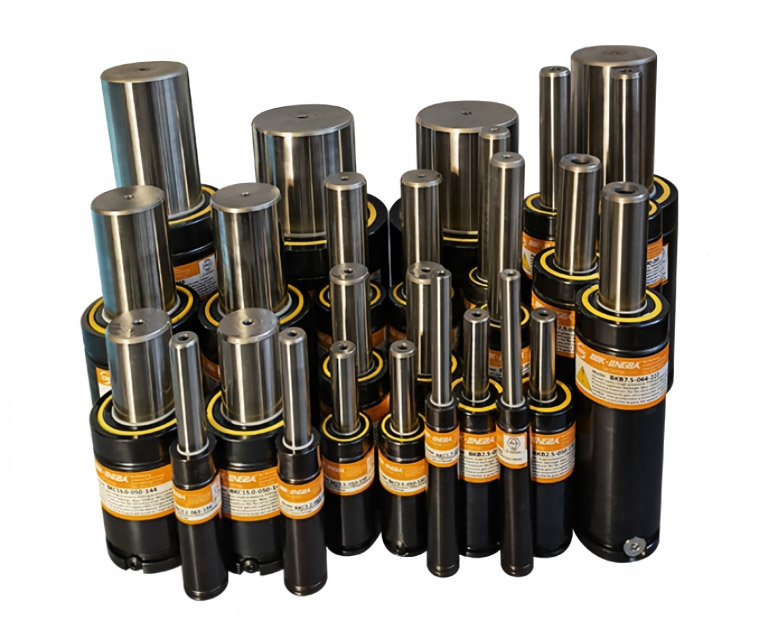
Pressure on Contact
Gas springs use gas pressure to produce a net force. The pressure acts on arod or piston and results in a force pro
portional to the gas-charge pressure.Unlike a steel or urethane spring, the rated force of a gas spring is achieved on contact or as soon as the rod starts compressing. Force is calculated by mul tiplying the effective area of the rod or piston by its charge pressure—for exam ple, 1.0 sq. in. by 2000 psi = 2000 lb. Of force. Most gas springs are charged to 2175 psi or less.
Urethane and steel springs work on the principle of deformation of an elas tic material. The initial force on contact is effectively zero and increases pro-portionally with travel as the materialundergoes greater stress. To achieve a high initial force, a urethane or steel spring must be preloaded. During oper ation the preloaded spring undergoes a higher proportion of travel, causing spring life to decrease as the material reaches its fatigue limits.
Gas springs employ nitrogen because it is nonreactive, commonly available at the required pressure and inexpensive—other inert gases cost far more than nitrogen. Air is undesirable due to its significant oxygen and moisture con-tent. On the other hand, dry nitrogen does not react with lubricating oils nor does it corrode cylinder components.
Upon compression,gas-spring pres sure increases in proportion to the decrease in gas volume. If the volume is halved, the charging pressure doubles.For this reason, it is desirable to include significant added volume, thus reducing the amount of pressure increase caused when the cylinder piston rod is com pressed.As the pressure increases, force
increases in direct proportion. For most applications, the pressure should not be increased by more than 75 percent of the spring’s at-rest pressure. This results in coolertemperatures within the spring,facilitating longer gas-spring life. Cer-tain metalforming operations, deep drawing for example, may require avery flat force curve along the lines of a 10 to 20-percent increase. However, try-ing to achieve a pressure increase of less than 10 percent is impractical because gas-volume requirements are so great.
All Types for All Needs Three main types of gas springs find
use in stamping dies: self-contained,linked and manifold.
Self-contained nitrogen gas springs contain pressurized gas in an enclosed cylinder body and seal on either the rod or piston. These precharged units may be filled or discharged to a desired pressure via a check valve. This means that the force they produce is preset before installation into the die. A hydraulic or electronic load cell meas-ures the force without loss of gas from the spring.
Generally, rod-sealed gas springs have a more com pact height than piston sealed models, and the pis ton in a rod-sealed spring acts only as a retainer and performs no sealing. The force-producing area of this type of spring cen ters around the piston rod diameter, with the hardened and polished rod acting as both a sealing and guiding surface for the spring. In gen-eral, rod-sealed units exhibit longer cycle life than piston-sealed gas springs.
Piston-sealed gas springs seal on the ID of the cylinder body,with force pro duced in the area of the piston diame ter. Piston-sealed units offer more force tonnage per the OD of the gas spring, but tend to be taller since gas volume must be added vertically.
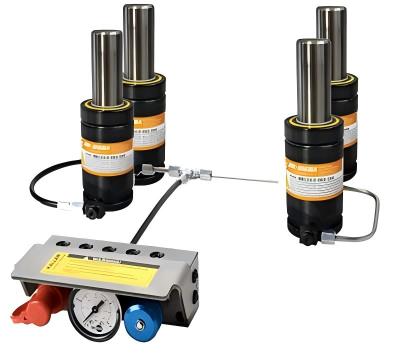
Standard self-contained nitrogen gas springs may be piped to a common pressure control panel, allowing for linked operation.A linked arrangement enables users to fill, discharge and mon itor system pressure from outside of the die. Linking springs together brings a big advantage—uniform and verifiable pressure throughout the system. Link
ing may employ different piping options, most using o-ring face seals at each fitting. Some manufacturers can provide pre-assembled and tested link systems on a subplate, enabling hassle free installation. Special hoses and fit tings make linking of smaller cylinders a simplified process as compared to just a few years ago.
Manifold-type gas springs are hous ing and rod assemblies threaded into a thick plate or manifold, drilled out to accommodate gas volume.A control panel is ported to one side of the manifold plate. Because the manifold becomes part of the die set, the manifold must be incorporated during die design.
Mind Pressure and Lube In general, gas-spring maintenance is
a simple affair. When removing a die for routine maintenance, toolroom per sonnel should use a load cell to verify spring pressure. Spring manufacturers can provide a schedule for conducting pressure checks based on number of hits undertaken by the springs. Users also should allow for adequate die lubricant drainage from pockets sur rounding the springs, which helps pro long die life. Should gas springs require repair, most can be reworked in only minutes by changing out the internal cartridge or seals. The repairable design of gas springs brings a cost advantage.
Gas springs—in a variety of shapes,
forces and diameters—can answer the call in practically every situation where force is needed within the die. Applica tions include lifting stock, holding a bead in a draw die and stripping apunch during blanking. Gas springs also have made inroads for specialty applications such as part ejection.
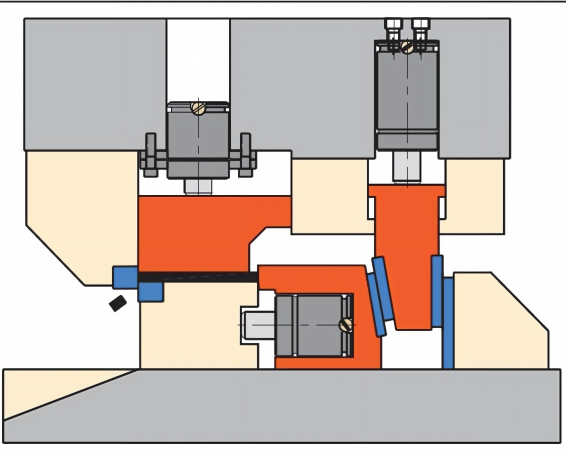
This diagram shows gas springs used for drawing and part ejection, with linked springs contained in the upper die.
Thinking of switching from coil to gas? If a die runs at high-volume production rates and its coil springs require frequent replacement, gas springs are alternatives that may reduce downtime caused by such spring replacement. If a change is called for, retrofit can be sim ple, often only requiring minor modi fications such as the use of a spacer because gas springs may be shorter than the coil springs they replace. In most cases, fewer nitrogen gas springs will be needed to achieve the desired total force.And in nearly all cases, gas springs are available in diameters that match those of the coil-spring pockets.
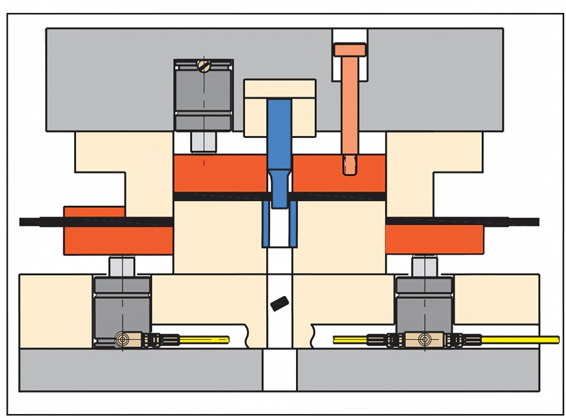
This cutaway of a blank and punch die shows a linked nitrogen-gas-spring system in the lower die.
Nitrogen gas springs offer a host of benefits to stampers looking to
get the most out of tooling. They:
• Provide on-contact force and require no preloading;
• Are available in compact profiles that require less die shut
height; provide high, repeatable forces and offer long life cycles;
• Are compact and produce high forces, enabling achievement of desired force with fewer springs;
• Can be repaired simply and economically;
• Can be operated in a linked system, providing pressure control via a control panel located outside of the die.
BeiBeiKang Develop Co.,Ltd


