Welcome to BeiBeiKang Develop Co.,Ltd
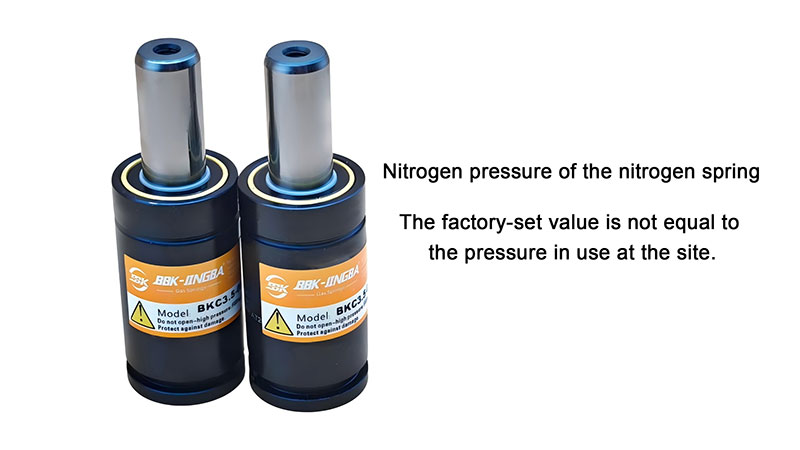
For experienced technicians engaged in equipment debugging, they have almost certainly encountered this strange phenomenon:
When nitrogen springs are inflated strictly in accordance with the parameters marked on the nameplate, after being installed on the machine, the output does not match the design value at all. It won't take long before the pressure is released and leakage occurs. They have to repeatedly make corrections, which not only wastes time but also delays the project schedule.
The root cause of the problem lies in the confusion between the factory pre-charging pressure and the working pressure on site!
✅️Factory pre-charging pressure (free state pressure)
The nitrogen pressure indicated on the product label refers to the internal air pressure within the nitrogen gas spring when it is completely unloaded and the piston rod is fully extended and stationary.
It is merely the initial base pressure and by no means the actual output pressure under compression conditions.
✅️On-site working pressure (compression pressure)
When the piston rod is pushed in, the space inside the cylinder decreases, and the nitrogen gas is compressed. The pressure will rise simultaneously. The larger the compression stroke is, the higher the internal pressure will be, and the greater the output elasticity will be.
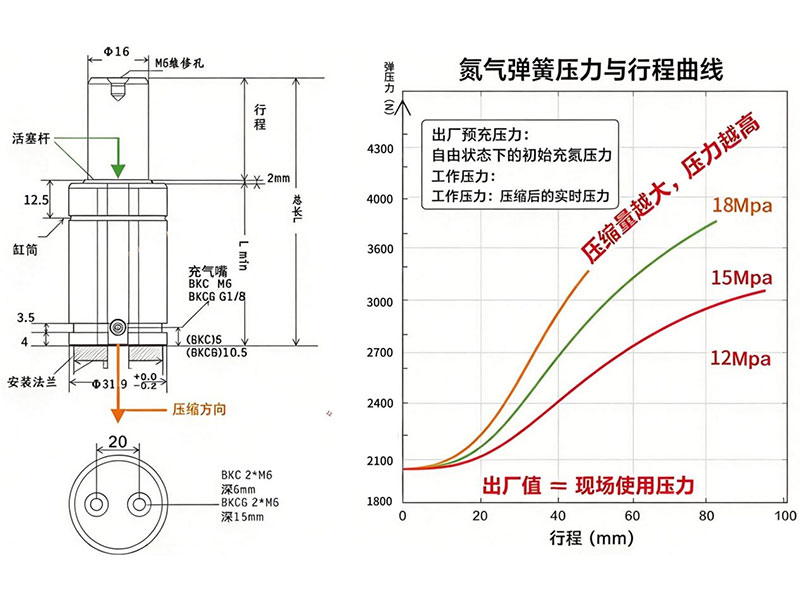
Many people mistakenly believe that the pressure indicated on the nameplate is the actual usage pressure, and they directly and blindly add nitrogen gas on site.
Once the limit is exceeded, the compression of the spring will immediately exceed the pressure limit, causing the sealing components to overwork and age rapidly. This will lead to short-term oil leakage and long-term direct damage to the cylinder body, posing a significant safety risk.
Nitrogen gas springs are high-pressure vessels; prior to shipment, Beibeikang performs precise nitrogen charging and pressure testing in a temperature-controlled environment.
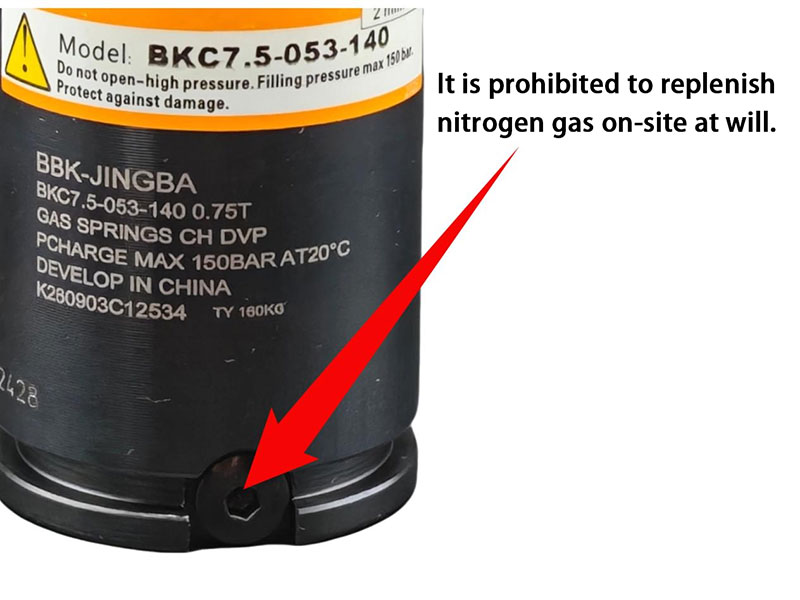
Due to fluctuations in ambient temperature, potential pressure gauge errors, and the lack of specialized tooling, unauthorized nitrogen charging can easily lead to excessive pressure, creating significant safety hazards.
👉If insufficient output force is detected, prioritize checking the following: installation parallelism, preload, and the presence of radial loads; do not immediately consider re-inflation.
If pressure adjustment is required, it is recommended to return the unit to the Beibeikang factory for nitrogen refilling and recalibration under standard, constant-temperature conditions.
1. Constant-temperature calibration and nitrogen filling:Pre-charging is performed under standard 20°C conditions with strict pressure tolerance control; pressure curves are tested for every single unit prior to shipment to ensure consistent output force across the same model of springs.
2. Pressure safety redundancy design:The cylinder barrel and sealing components are designed based on the maximum compression pressure, incorporating a safety margin to prevent damage to the parts caused by pressure fluctuations.
3. Clear nameplate markings:The nameplate specifies the maximum permissible charging pressure; the parameters are clear at a glance, facilitating model selection and verification by engineers while helping to avoid the risk of over-pressurization.
4. Comprehensive pre-shipment inspection:Each unit undergoes a pressure-retention test to eliminate micro-leaks prior to shipment, ensuring stable pressure upon delivery.
A: We do not recommend inflating the unit on-site yourself. Without a temperature-controlled calibration environment, it is difficult to control the pressure precisely; compression can easily cause the pressure to exceed the maximum limit, damaging the seals and creating safety risks. Please return the unit to the factory for pressure adjustments.
A: Yes. Nitrogen is a compressible gas; as the piston rod is compressed further into the cylinder, the internal volume decreases and the internal pressure rises, resulting in an increase in output spring force—a characteristic reflected in the pressure-stroke curve.
A: Under normal operating conditions, brand-new Beibeikang nitrogen springs come pre-charged to the standard pressure and do not require on-site nitrogen replenishment. A return to the factory for recharging is considered only if slow pressure loss occurs due to long-term storage.
A: Represents the maximum permissible nitrogen charging pressure for this model of nitrogen gas spring; the pre-charge pressure must absolutely not exceed this value, as doing so could lead to over-pressurization upon compression and damage the product.
Prepared by: Dongguan Beibeikang Precision Machinery Technology Co., Ltd.
For further technical discussion, please contact Engineer Liu at 13620045661 or 13802381201.
Have you ever experienced abnormal nitrogen spring output during debugging due to an incorrect nitrogen charging pressure?
BeiBeiKang Develop Co.,Ltd


