Welcome to BeiBeiKang Develop Co.,Ltd
Original factory lead times are long, and prices increase year by year. When you finally find a substitute, you encounter problems such as mismatched mounting holes, cylinders that won't fit in the die cavity, or unstable stamping force. Ultimately, you have no choice but to mill the die plates and modify the die structure, delaying trial runs and mass production.
Many people have a fatal misconception: as long as the tonnage is the same, an imported nitrogen cylinder can be directly replaced.
In-place interchangeability is never determined by a single tonnage figure! A reliable interchangeable selection logic relies on checking 4 core items.
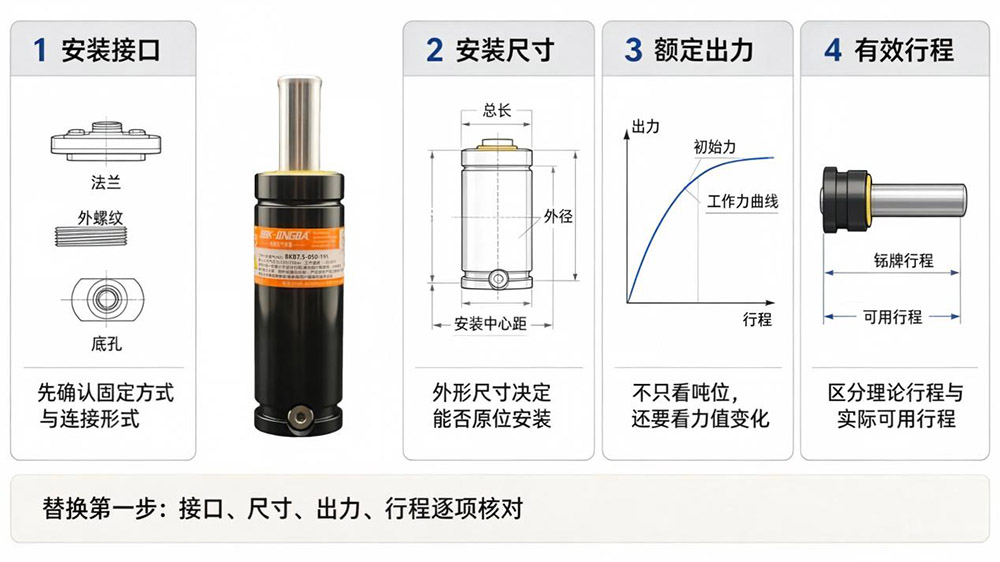
Flange, external thread, or bottom hole—the mounting structure determines whether it can be properly locked and assembled. If the interface does not match, it cannot be installed even if all other parameters are correct.
2. External Installation Dimensions: Determines whether it can fit into the die cavity.
Outer diameter, total length, and mounting center distance—any deviation in any of these dimensions can result in it not fitting or causing interference during die closing.
Even with the same rated tonnage, the full-stroke force curve varies significantly between different brands. If you only match the initial tonnage, force fluctuations during stamping will lead to poor blank holding and springback issues.
For many imported models, the marked stroke ≠ the actual usable stroke. Blind replacement can easily lead to die collision, cylinder damage, or the piston rod bottoming out prematurely.
II. Core Replacement Principle: Dimension and Interface Matching for Die Modification-Free Replacement
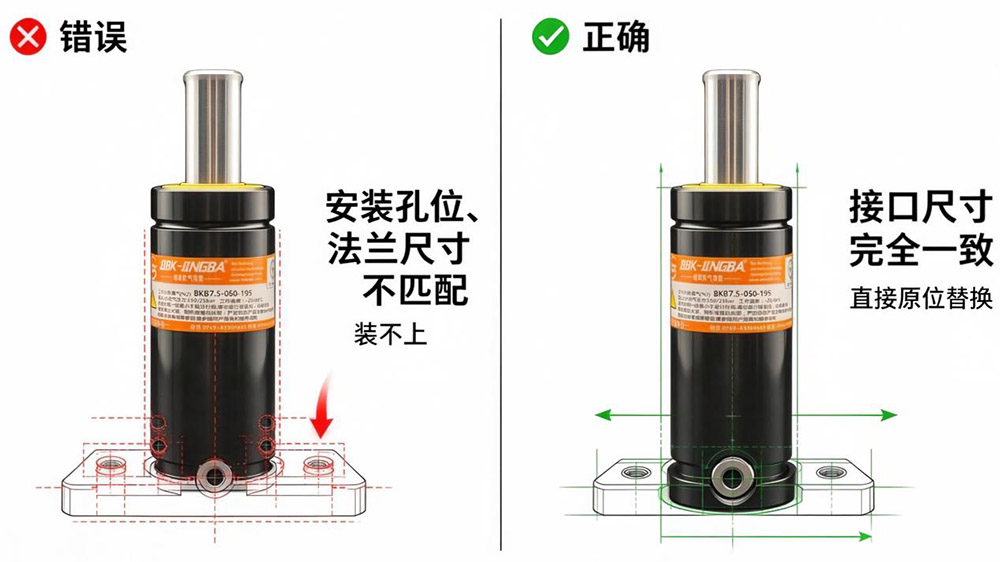
The Golden Rule of Replacement: Only when interfaces and hole position dimensions are completely identical can direct in-place installation be achieved.
Wrong approach: Mismatched flanges and mounting holes require secondary machining of the die, wasting labor, increasing costs, and delaying delivery.
Beibeikang's alternative solution: Benchmarked against the interfaces, flanges, and hole positions of original imported nitrogen cylinders, it requires no template modification and can be directly assembled on the machine, saving the cost of die modification and rework.
III. Beyond Dimensional Replication: Force Characteristics Must Also Match
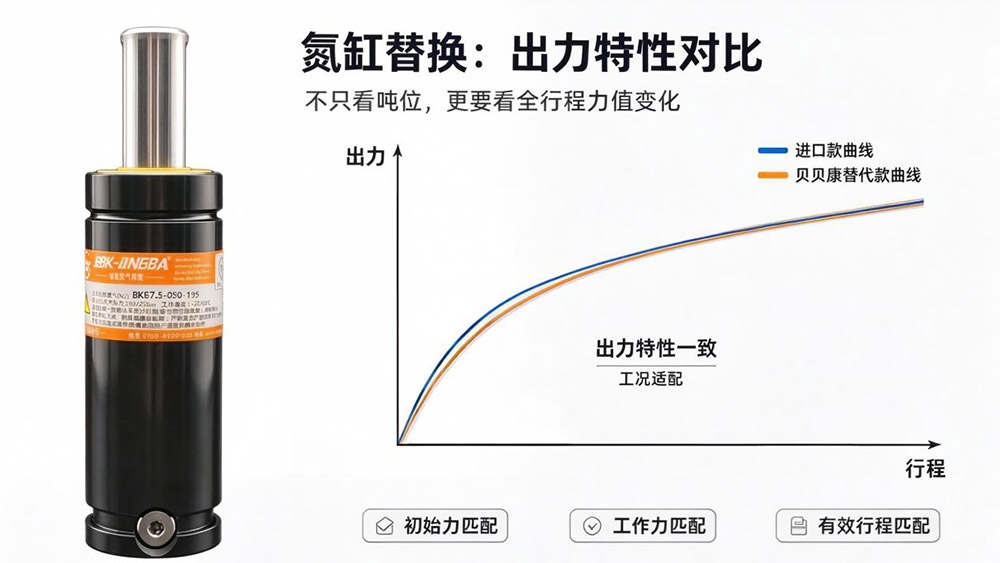
The Beibeikang alternative model does not just replicate external dimensions; it also synchronizes force characteristics. The initial force and full-stroke working force curves are benchmarked against the original imported nitrogen cylinders, ensuring stable stamping conditions. The bending, blank holding, and forming effects remain consistent with the original, preventing fluctuations in product yield due to cylinder replacement.
Core Advantages of Beibeikang Nitrogen Spring Replacement: Benchmarked against mainstream imported nitrogen cylinder specifications on the market, offering multi-series coverage and supporting in-place interchangeability without die modification. 100% factory inspection: Dimensions, force, and stroke are individually verified to ensure high parameter consistency and reduce on-site trial and error. In-house R&D and manufacturing: Controllable lead times, fast after-sales response, and no long waits for imported goods scheduling. Piston rod coating and fatigue-resistant sealing configurations: Suitable for high-speed continuous stamping, with stable service life.
Q: Is looking only at tonnage sufficient when replacing an imported nitrogen cylinder?
Absolutely not! Tonnage is only one indicator. If any of the following—the full-stroke force curve, effective stroke, or mounting hole positions—do not match, it will cause die malfunctions.
Q: For in-place interchangeability, can all imported models be directly replaced?
A: Beibeikang's standardized replacement series covers most mainstream models. You only need to provide the original nitrogen cylinder model and drawings. We will verify the interface, dimensions, force, and stroke in advance to confirm the adaptation plan and help you avoid pitfalls.
Q: After replacement, is large-scale re-debugging of the die required?
A: Provided that parameters are matched and force curves are consistent, significant die adjustment is generally not required. The original stamping process parameters can be maintained.
Prepared by: Dongguan Beibeikang Precision Machinery Technology Co., Ltd.
For further technical exchange, please contact: Engineer Liu at 13620045661 / 13802381201
Have you ever experienced a failed imported nitrogen cylinder replacement that forced you to modify your die?
BeiBeiKang Develop Co.,Ltd


