Welcome to BeiBeiKang Develop Co.,Ltd
Using the same nitrogen cylinder, it's barely usable in automotive parts molds, but when used in precision 3C parts, it directly damages the product and causes scratches and defects. Conversely, a miniature nitrogen cylinder suitable for 3C is insufficient in output and unstable in pressure when placed in automotive molding molds, causing parts to frequently wrinkle and crack.
Core misconception: Selecting a model based solely on tonnage, ignoring differences in operating conditions!
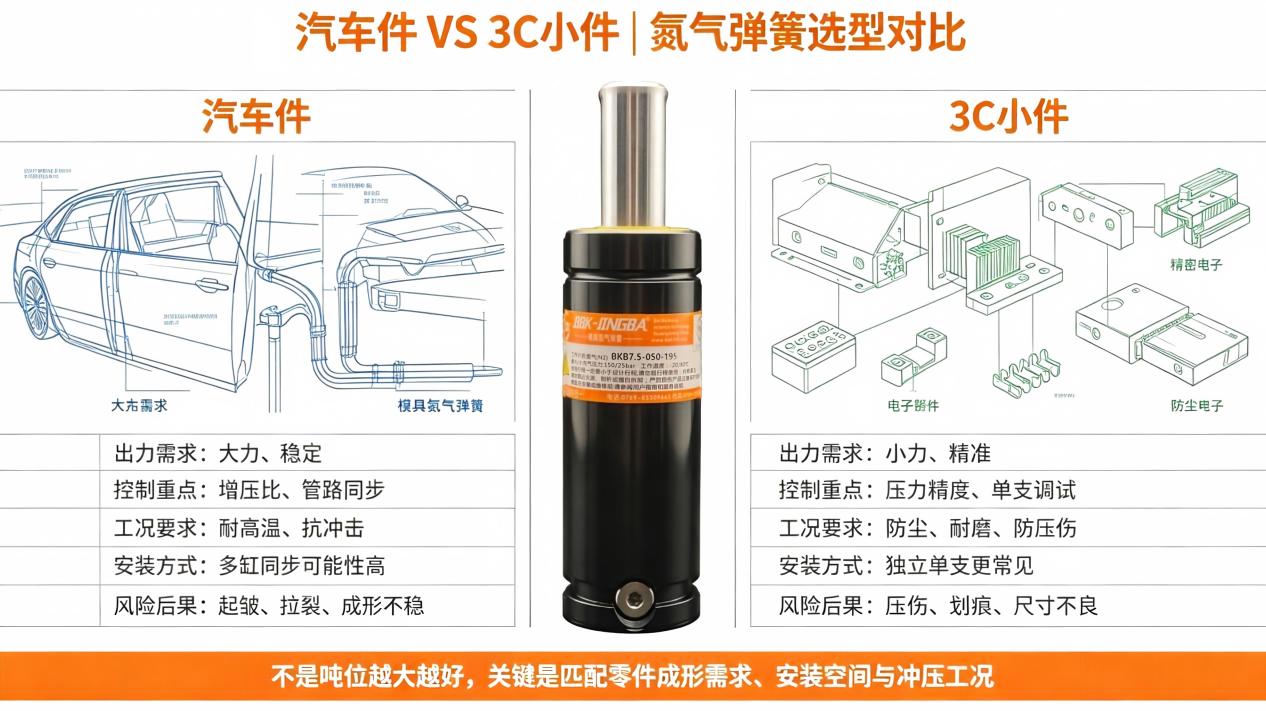
The stamping of large automotive parts and the precision stamping of small 3C parts have completely different standards for the output characteristics, precision, heat resistance, and installation methods of nitrogen cylinders.
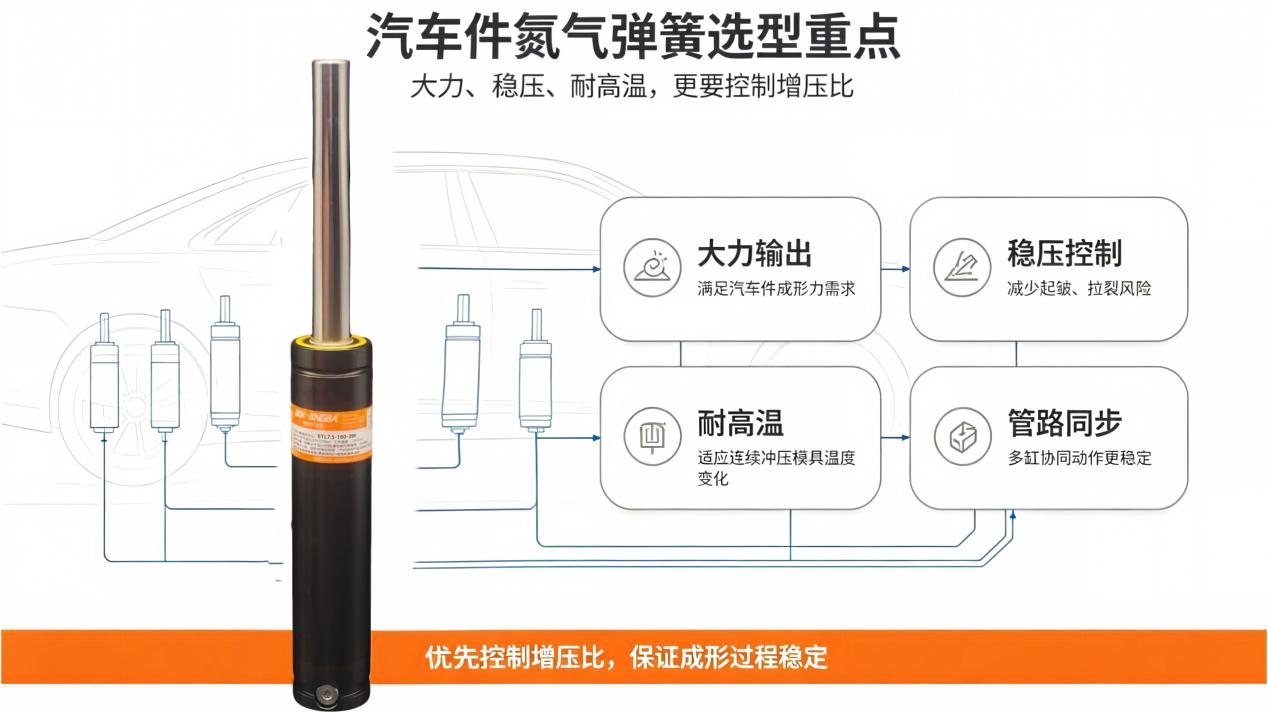
Stamping of automotive body panels and structural parts involves large strokes and high forming force requirements. Under continuous high-speed stamping, the mold temperature continues to rise, and many molds also require multiple cylinders to be connected in parallel for synchronization.
✅Key Selection Points:
1. High output : Meets the high output requirements for sheet metal stretching and forming, ensuring that the pressing material does not become loose .
2. Stable pressure control : Minimal force fluctuations throughout the molding process, reducing wrinkling, tearing, and scrapping from the source .
3. High temperature resistance : Adaptable to continuous stamping temperature rise, no air leakage and no force drift at high temperatures .
4. Piping synchronization : The multi - nitrogen cylinder parallel connection scheme ensures good synchronization and consistency, avoiding uneven load distribution.
Beibeikang's nitrogen springs for automotive molds are specifically tuned for automotive stamping conditions. The cylinder block's temperature-resistant sealing structure is optimized, and the multi-cylinder synchronization solution is mature. They are used stably in large-scale automotive molds, effectively reducing the defect rate of stretch forming.
3C products such as casings, connectors, and precision electronic components are thin, have high appearance requirements, and have limited internal space. They are mostly used individually, and even a slight increase in pressure can damage or collapse the appearance.
✅Key Selection Points:
1. Precise with small force : The force output is linear and controllable, with small pressure error and precise force control .
2. Miniature and compact : Small in size, suitable for installation in narrow mold cavities .
3. Dustproof and wear-resistant : The precision-sealed dustproof structure prevents debris and dust from easily entering the cylinder, extending its service life.
4. Independent single unit : Each unit can be debugged independently, without the need for parallel piping, making debugging simple and flexible .
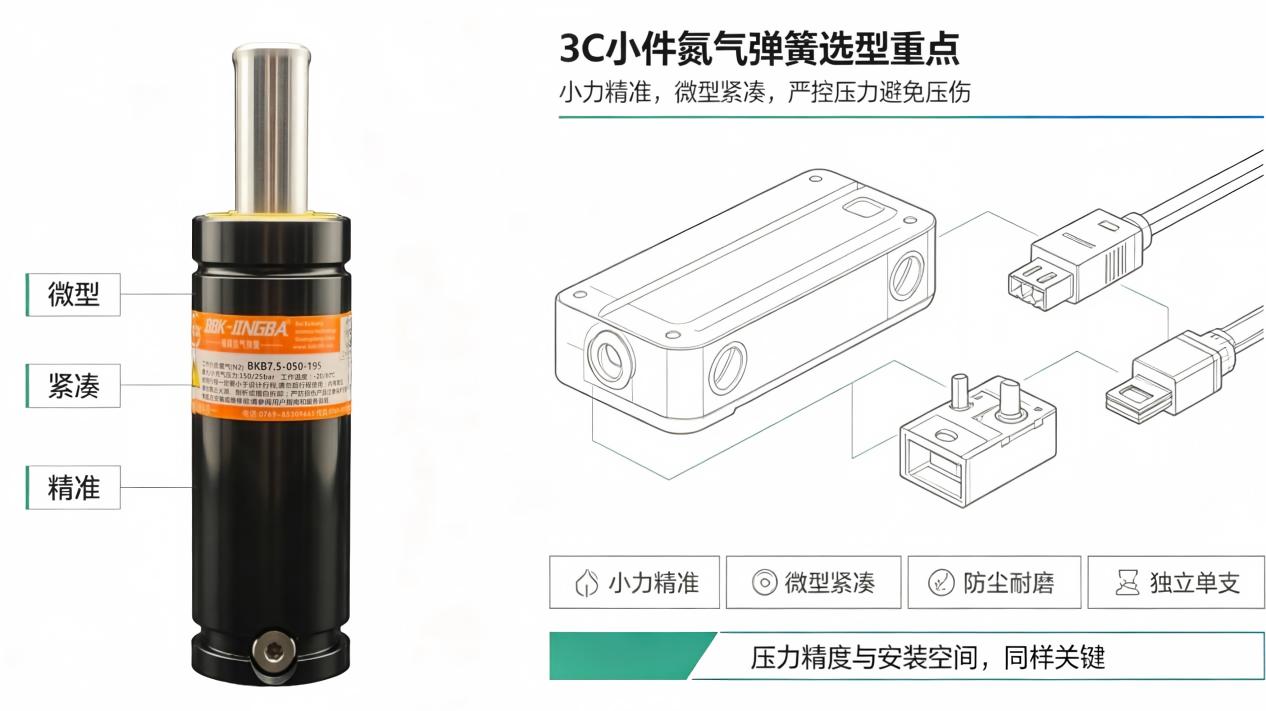
Beibeikang 3C Precision Nitrogen Springs are specially developed for precision small parts. They feature fine force adjustment, a full range of miniature specifications, and dustproof, wear-resistant, and sealed configurations, solving the problems of appearance damage and scratches. They are suitable for high-speed stamping in consumer electronics.
The demand for nitrogen cylinders for automotive parts and 3C small parts is vastly different. A comparison chart clarifies the differences, so that selection is no longer based on intuition.
Key point: Bigger isn't always better!
All selections must adhere to three general premises:
✅ Calculate a reasonable pressure margin and avoid using it at full pressure or the limit.
✅Allow extra safety margin in work schedules to prevent overtravel.
✅Check in advance the in-mold installation space, stamping speed, and continuous operation conditions.
Beibeikang nitrogen springs cover a full range of specifications for large automotive parts and small precision 3C components. Customized selection solutions can be provided according to mold working conditions, and interchangeability with imported brands is supported, eliminating the need for repeated trial molding and troubleshooting.
Q1: Can the nitrogen cylinder of a car model be used directly to machine small 3C parts?
A: Not recommended. Automotive parts have high output and high boost ratio, which can easily damage thin-walled 3C components; moreover, they are relatively large, and many small molds cannot accommodate them, and the force accuracy cannot meet the requirements of precision parts.
Q2: Can the miniature nitrogen cylinders used in 3C products be used in automotive stretching dies?
A: No. Miniature models have low power output limits, weak high-temperature resistance, and poor impact resistance. Continuous stamping in automobiles can easily cause rapid air leakage and force attenuation, directly leading to mass tearing.
Q3: When selecting a model, is it safer to choose one with a larger tonnage?
A: Misconception! Exceeding the tonnage limit can lead to minor issues like product damage and mold overload, or more serious problems like prolonged nitrogen cylinder overload, rapid seal failure and leaks, increasing mold repair costs. Matching the operating conditions is the safest approach.
Q4: Is multi-cylinder synchronization only necessary for car models?
A: Yes, most small 3C parts are used individually; for large automotive parts, stretching and forming requires multiple cylinders to synchronize the pressure ring, and unstable synchronization can easily lead to wrinkling and localized tearing.
Compiled and edited by: Dongguan Beibeikang Precision Machinery Technology Co., Ltd.
For further technical discussions, please contact: 13620045661 / 13802381201 (Mr. Liu)
BeiBeiKang Develop Co.,Ltd


